A side project
Home Assistant
A few smart switches turned into a Home Assistant setup that quietly handles lighting, family routines and parts of our home network.
- Home Assistant
- Synology
- Zigbee
- Z-Wave
- AdGuard Home
I started playing with Home Assistant in 2023 because I wanted the different devices in our home to work together. The first version was a small VM on my desktop in our old place. I bought a Synology DS923+ at an IT show that June and spent the summer setting it up. When we moved in September, I had neutral wiring put throughout the new house and set up Home Assistant OS on a VM on the NAS. It has grown well beyond the few Aqara switches I used to test the idea.
To me, a smart home is most useful when nobody has to ask it to do anything. Saying “Hey Google” to turn off a light is still a person remembering the job. I want the house to notice what is happening and get on with it. If our family can be a bit lazier because a routine simply takes care of itself, I count that as a success.
What it does around the house
The lights react to motion, door state, time and weather. In the toilets I use a version of the “wasp in a box” idea, combining a PIR sensor with the door sensor so a quiet motion detector does not immediately mean the room is empty. The balcony blinds respond to the rain forecast, forgotten switches turn themselves off, and my phone’s location tells HA when to preheat the water as I head home from the gym.
With four kids, the family routines have become just as useful as the hardware. There are TV rules for school days and holidays, a chores dashboard, timed announcements and a spelling assistant that connects Telegram to the speakers in the house. I can configure the word list in Home Assistant or send it through Telegram; once the test begins, a wireless switch lets the kids move through the words.
Home Assistant also brings parts of the network together. My router and NetAlertX help identify devices, while AdGuard Home applies DNS rules per device for YouTube and other services. HA gives me one place to use that information for checks and routines instead of treating the network as a separate hobby.
It also helps when I am away. I can wake my home PC through HA, connect to it with Parsec if something urgent comes up and reach my other devices through my Tailscale network.
The setup behind it
As of October 2026, the HAOS VM on the Synology connects roughly 162 devices through Zigbee, Z-Wave, Wi-Fi and Bluetooth. It has 95 automations and 24 scripts. The diagram below is the short version of how those pieces fit together.
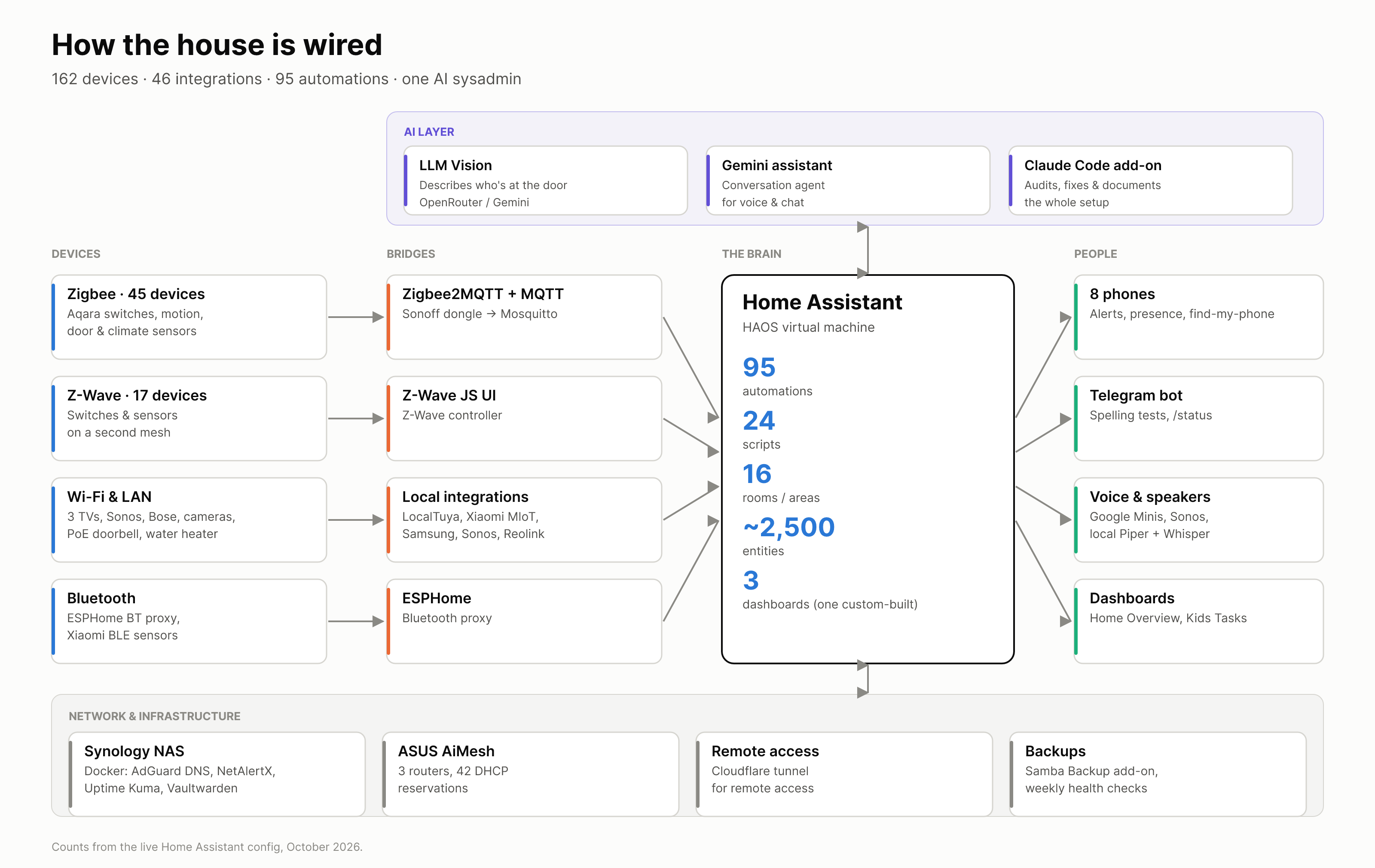
I built a dashboard so the useful things are easy to see without digging through entities. More recently I brought Claude Code into Home Assistant. It now helps me inspect logs, debug automations, update the dashboard and run a weekly review. I still decide what the house should do, but I no longer have to hand-edit every YAML file to get there.
There is plenty I am still fixing. A motion sensor cannot see somebody standing still, an old rule can outlive the routine it was made for, and a good dashboard does not make a bad automation less annoying. I wrote more about how the setup grew, including the family bits and the failures, in the full Home Assistant post.