Back at the pool, this time as Dad
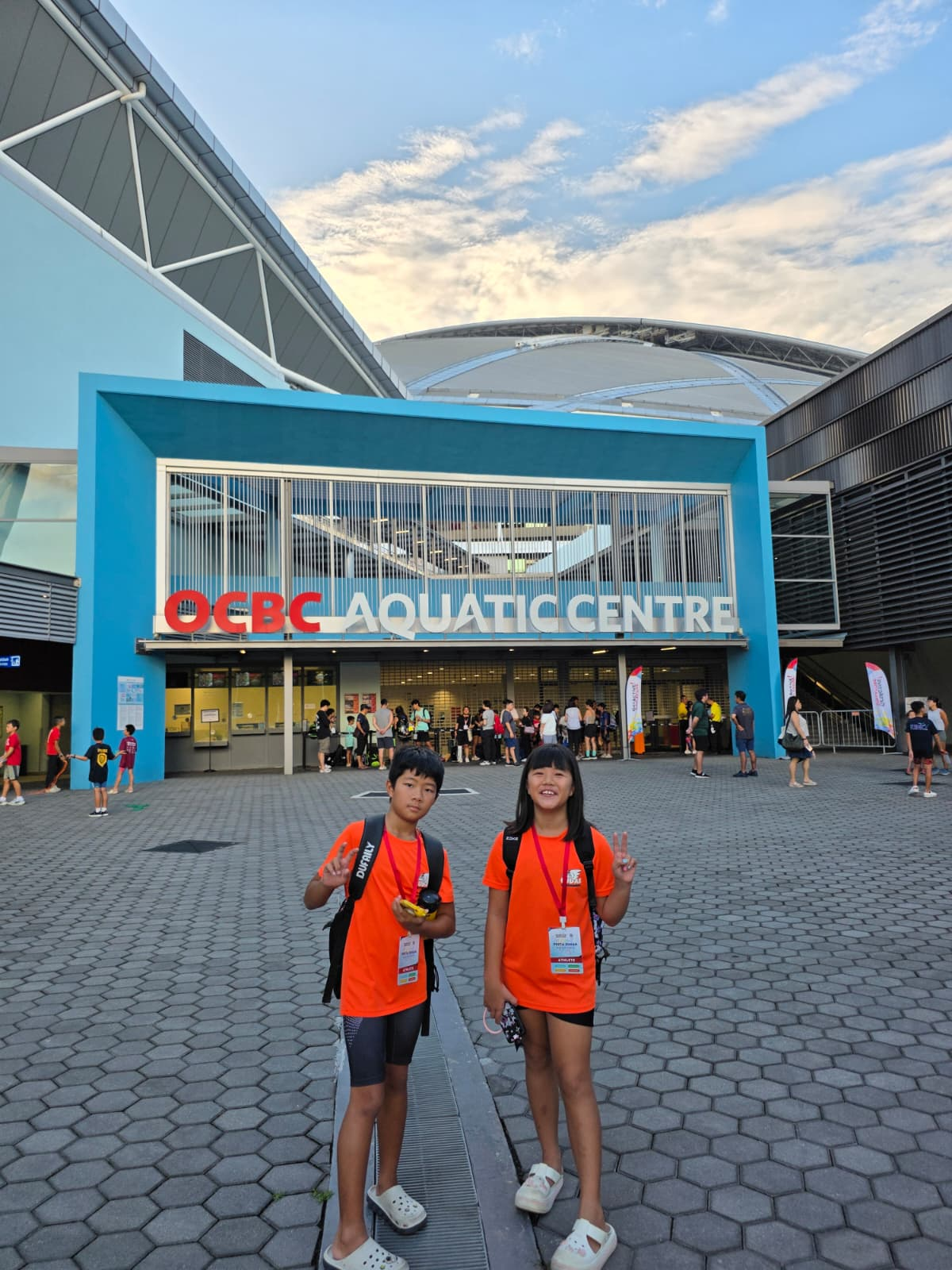
The photograph above was taken outside the OCBC Aquatic Centre at Pesta Sukan on 19 June 2026. Evan Liew and Sarah Liew are in their orange team shirts with their passes around their necks. It looks like the sort of photograph every parent takes at a meet. For me, it marks their first major swimming competition together and the point at which this whole swim-parent business began to feel quite real.
I grew up swimming and spent some time doing it semi-competitively, although I never pursued it as seriously as some people around me. My youngest brother was a competitive swimmer for our country club, and Uncle Jack, who trained me about thirty years ago, is still coaching today. With all that history, you might think I would have known exactly what I was getting the family into. I knew the sport from inside the pool; I had much less idea what it would be like to build family life around it from the outside.
It started with proper swimming lessons
In 2024, I took my two older children back to Uncle Jack. Evan was nine and Sarah was eight, and my plan was simple enough: let them learn their strokes properly from someone I trusted. We have four kids, work and the usual household chaos to manage, so I was certainly not looking for another complicated timetable.
Then Uncle Jack asked whether I would consider putting Evan in a competitive squad. That question took a little more thought than an ordinary change of swimming class. I spent about two months doing research, meeting old friends from the swimming world for meals and talking with Jack, now as one father to another rather than as the boy he used to coach. On 2 January 2026, Evan started his competitive swimming journey with AquaTech Swimming. Sarah followed in March.
The research did something to me too. I kept checking clubs and good swimmers in Singapore, watching swimming technique videos on YouTube and thinking about which meet the kids might try next. I had not swum in 30 years, but all that time spent looking into the sport made me want to get back in the water. From January to March 2026, I swam three times a week, giving technique, endurance and sprints their own days. I had set out to find the right place for the kids and found myself becoming a swim parent before I really knew it. When AquaTech accepted Evan into its Developmental Squad, I also made myself a promise: I would show him by doing, not just by talking, that starting later did not make something impossible. The gym came later, as another way to keep that promise.
The change from lessons to training happened quickly enough on paper. In real life it meant figuring out how to get everyone where they needed to be, what they needed to eat, what equipment had disappeared since the last session and whether I had remembered the reporting time correctly. I have written code to keep parts of our household running, yet the swimming bag can still defeat me on an ordinary weekday.
A long day for a short race
Pesta Sukan was their first major competition together. By then Evan had already raced at smaller meets, and both children had spent months learning that training and racing ask for different things. Still, seeing them at the same big venue in their team shirts made the whole thing feel like a new chapter for us.
If you only see a result, it is easy to imagine that a meet is mostly about the thirty or sixty seconds in the water. There is the warm-up, marshalling, waiting for an event, eating at a sensible time, resting, getting ready again and trying to catch the actual race from a position where I can film more than a lane rope. By the end of the day, a handful of short swims has somehow occupied almost every waking hour.
The times matter, and I keep track of them more closely than I ever expected to. At Pesta Sukan, Evan swam the 50 m freestyle in 35.30 seconds, while Sarah recorded 48.27 seconds in the same event. Those numbers are useful markers, but they do not tell me how they handled a crowded meet, what they were working on in training beforehand or how they felt when a race did not go the way they hoped.
I am learning to be careful about the questions I ask afterwards. It is tempting to go straight to the clock because it gives me an easy answer, especially when I have spent half the day staring at one. A race can tell us where the next bit of work might be, but I do not want every conversation on the way home to become a performance review. They are children who happen to swim competitively, and they still have school, friends and plenty of growing up to do outside the pool.
Their journey, and mine from the side
Evan and Sarah have come into the sport in their own ways. Evan was the one who prompted the first serious conversations about competitive swimming, while Sarah joined a little later and found a group of friends at the club surprisingly quickly. I can give them the same lift to training and cheer from the same stand, but I cannot expect the experience to mean exactly the same thing to both of them.
There is also something slightly strange about watching a sport from my childhood become part of theirs. I remember being the swimmer; now I am the person sorting out meals and transport, looking for them before a race and trying to be useful without becoming another source of pressure. I am still figuring that out, and I suspect I will be doing so for quite a while.
I do not know how far they will take swimming, or how long they will want to keep doing it. For now, they are training, racing, learning and giving me a reason to spend a lot of time at the pool again. I am glad I get to be there for it, even if my camera roll suggests I still have some work to do on filming a race properly.
October 2026 update: I have started keeping Evan’s and Sarah’s meet history, PBs and squad goals together on their own profile pages, where I can add the next chapter as it happens.